Given SHINGANGE
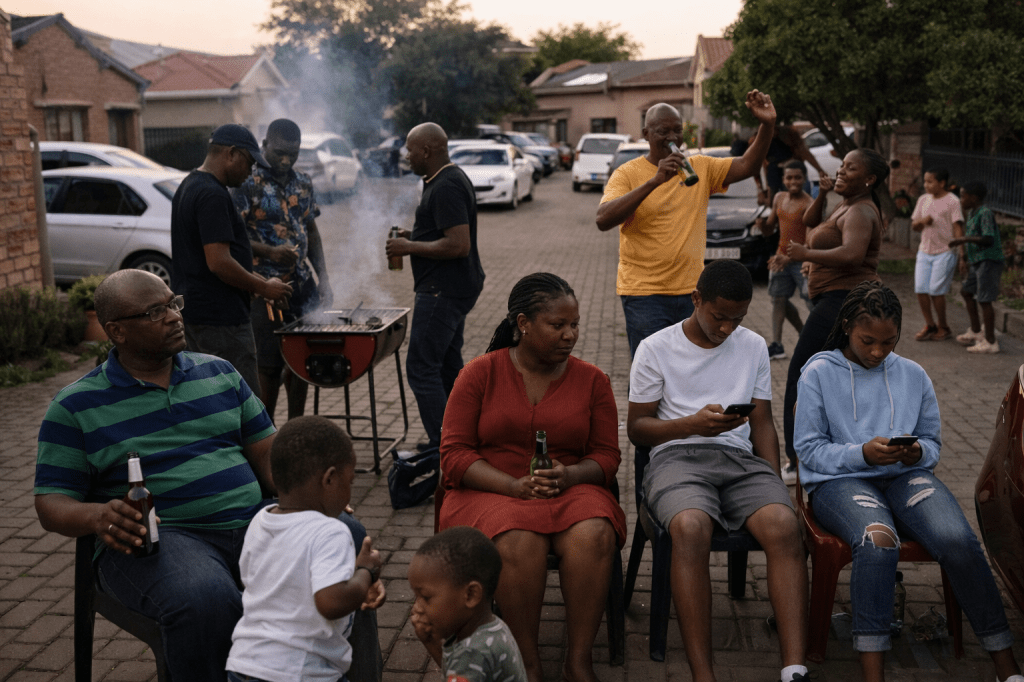
Over the Christmas period, I watched families come together in ways that felt familiar and expected. Homes filled up. Photos were taken. Conversations followed well rehearsed paths, work, children, progress, plans. From the outside, it looked like togetherness as we have come to know it.
Yet I could not escape the feeling that these gatherings no longer carry the same meaning they once did.
This is not a rejection of family, nor a dismissal of what these moments can offer. Family time can still be grounding and necessary. But I found myself questioning whether presence has begun to replace connection, and whether obligation is quietly being mistaken for closeness.
I wondered when going home became something we see as a duty rather than a choice.
Family as Ritual Rather Than Relationship
Christmas has become one of the most powerful family rituals we have. It is a fixed point in the calendar where attendance is assumed and absence is interrogated. Being there is often treated as proof of care, regardless of how that presence feels or what it costs.
Rituals are not inherently bad. They provide continuity and structure. But when rituals survive longer than their meaning, they risk becoming hollow performances.
In many families, Christmas gatherings now feel less like shared rest and more like scheduled compliance. You arrive because it is expected. You stay because leaving early raises questions. You participate because not participating carries consequences. The result is a room full of people who are physically present but emotionally guarded.
Togetherness, in this context, becomes procedural rather than relational.
The Quiet Pressure to Perform
One of the most striking features of modern family gatherings is how easily they turn into stages.
Success is displayed through cars parked outside, clothes worn inside, and stories told around the table. Conversations gravitate towards promotions, businesses, degrees, children’s achievements, and future plans. These topics are not harmful on their own. The problem lies in what they crowd out.
In unequal societies, achievement is not a neutral topic. It draws invisible lines between those who are progressing and those who are merely surviving. For some family members, these conversations affirm belonging. For others, they amplify silence.
When success becomes the safest currency of interaction, vulnerability disappears. Struggle becomes unspeakable. And the very space meant to offer refuge begins to reinforce hierarchy.
People leave feeling measured rather than held.
Obligation Versus Choice
There is a fundamental difference between being somewhere because you want to be there and being somewhere because you are supposed to be there.
Chosen presence allows honesty. Obligated presence requires performance.
Many people attend family gatherings while managing quiet resentment, emotional exhaustion, or unresolved conflict. They suppress parts of themselves to preserve harmony. They carry the emotional labour of keeping things pleasant. Over time, this creates distance rather than closeness.
In a world defined by rapid change, flexibility, and constant adaptation, this kind of emotional rigidity becomes unsustainable. Careers shift. Locations change. Identities evolve. Yet family expectations often remain frozen in an earlier version of who we were meant to be.
This mismatch creates tension, especially for those trying to survive and adapt in uncertain conditions.
When Family Becomes Restrictive
Family becomes restrictive not because it demands care, but because it sometimes demands conformity.
Unspoken rules govern how one should behave, what success should look like, how often one should show up, and what sacrifices are considered acceptable. Deviation is interpreted as distance. Distance is interpreted as betrayal.
Under these conditions, family stops functioning as a support system and starts operating as a control system.
This is rarely intentional. It emerges from fear, tradition, and inherited expectations. But the impact is real. Some people find that in order to grow, they need distance. Not because they lack love, but because proximity comes at the cost of selfhood.
That truth is difficult to admit in cultures that moralise family loyalty without examining its effects.
Holding the Positive and the Problematic
It is important to say this clearly. Family gatherings are not meaningless by default.
For many people, Christmas remains a rare moment of safety, laughter, and grounding. For some, it is the only time they feel seen. For others, it is a reminder that they are not alone.
These experiences are real and valid.
But so are the experiences of those who feel drained, diminished, or isolated by the same rituals. The problem arises when we assume a single meaning for family time and silence those whose experiences do not align with the ideal.
Togetherness does not guarantee connection. Tradition does not guarantee care.
Rethinking What Family Could Be
Perhaps the question is not whether family still matters, but how we allow it to matter.
What if family was less about annual obligation and more about honest presence. Less about display and more about listening. Less about measuring progress and more about acknowledging reality.
What if choosing distance at times was not seen as rejection, but as self preservation. What if showing up differently, or less frequently, did not automatically signal failure or disrespect.
These are uncomfortable questions. But discomfort often signals that a concept is being stretched beyond its original design.
Closing Reflection
I do not have final answers. What I have is a growing sense that the concept of family, like many social structures, is under strain. The world has changed faster than our expectations of one another.
Perhaps what we are witnessing is not the breakdown of family, but the fading of an old meaning that no longer fits the lives we are living. And perhaps the task ahead is not to abandon family, but to renegotiate it with honesty, humility, and care.
Not every gathering needs to be a performance. Not every absence needs to be explained. And not every family needs to look the same to still matter.

 Given SHINGANGE