Given SHINGANGE
There is a woman in Nhlaneki village, outside Giyani in Limpopo, who used to arrive at the communal tap before sunrise. Nobody knew when the water would run, or for how long. Sometimes it came for a few days. Then nothing. She would wait under the broiling Limpopo sun, her containers lined up in a queue that stretched down a dusty road, in her village.
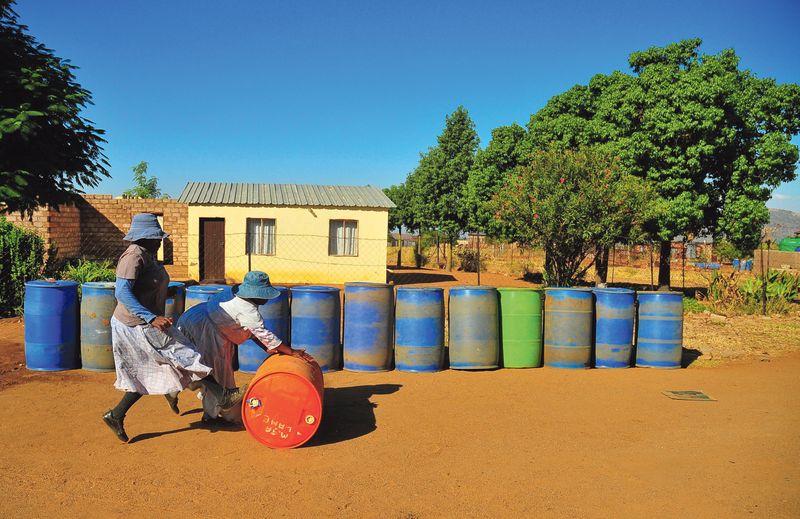
Women roll a drum filled with water down a street in Marulaneng after queuing for more than 12 hours to fill up. Photo: Lucas Ledwaba/ Mukurukuru Media)
That image — described in reporting by Mukurukuru Media (Source) — captures something that a budget line or a parliamentary briefing never quite can. It captures what thirty years of deferred promise actually looks like on the ground.
But here is the thing about that image. It made the news. The corruption did too. The delays did. The billions that vanished into procurement irregularities, that was front page.
What has not made the news, at least not with anything close to the same force, is what has quietly changed.
Where the Story Started
When Nelson Mandela became South Africa’s first democratically elected president in 1994, he inherited a country where, by his own account, 12 million people in rural areas, approximately 30% of South Africans had no access to clean drinking water. He said so himself, five years later, in his address to the World Economic Forum in Davos in January 1999: “In 1994, 12 million people in our rural areas, some 30% of South Africans, lacked access to clean drinking water. Since then, 3 million have gained access to that absolutely basic amenity.” (Source)
Giyani and its surrounding villages were part of that inheritance. The area around Greater Giyani Municipality in Mopani District has faced structural water access challenges rooted in geography — it is a drought-prone region with erratic rainfall, rarely exceeding 10 millimetres per day between 1994 and 2012, and high evaporation rates that can reach 18 millimetres per day. (Source: Matimolane et al., 2024, SAGE Journals — (Source)
From 2009 to 2010, the situation reached a crisis point. The water level in the Middle Letaba Dam dropped dramatically, Greater Giyani Municipality was declared a disaster area, and emergency funding was activated. But emergency funding is not infrastructure. The taps kept running dry.
The Billions and the Headlines
In August 2014, the Giyani Bulk Water Supply Project was allocated a budget of R500 million. The goal was to bring reliable water to 55 villages. That budget subsequently ballooned to R4.5 billion. (Source)
Corruption Watch’s 2020 report on South Africa’s water sector documented the procurement irregularities that followed, tracing how expenditure decisions bypassed the government’s own structures and procedures, with the Auditor-General finding the acquisition of contracts to be irregular. (Source)
Four ministers of water and sanitation came and went, Nomvula Mokonyane, Gugile Nkwinti, Lindiwe Sisulu, and Senzo Mchunu, without completing the project. (Source) The corruption story, the delay story, the ballooning budget story, these were reported. They stuck. They became the dominant frame through which most South Africans understood Giyani’s water situation.
And then something started to change. Quietly.
The Progress That Didn’t Make the Front Page
By August 2024, twenty-four villages — the first phase of the reticulation project — were receiving water. This was confirmed in parliamentary proceedings by Minister Majodina on 27 August 2024. (Source)
By December 2024, the Giyani Water Treatment Works had been refurbished and restored to its original capacity of 30 million litres per day, after previously operating at roughly half that capacity. (Source)
As of a November 2025 parliamentary presentation, the overall project stood at ninety percent completion, with full completion now anticipated by May 2026. Phase 2, covering the remaining thirty-one villages is planned for the 2025 to 2026 financial year. (Source)
This is not perfect. Some villages still rely on water tankers and boreholes. The project is still not finished. But twenty-three of twenty-four Phase 1 villages now have reticulation and household metered connections — confirmed by Cabinet. (Source)
Where were the headlines?
The Vacuum and Who Fills It
This is the central problem. Government communication in South Africa has a pattern: it is reactive rather than proactive, defensive rather than narrative-setting. When things go wrong, the story gets told by journalists, by opposition parties, by civil society. When things improve, the story is mostly not told, or it’s told in a press release that reaches nobody.
The result is a narrative vacuum. And in the information environment of 2026, narrative vacuums do not stay empty. They are filled with old headlines that keep circulating, by political actors with an interest in the failure story, and, increasingly, by social media dynamics that reward outrage over resolution.
This is not merely a communication failure. It is a strategic vulnerability.
District Six: A Promise From 1998, Reported in 2026
Consider what President Cyril Ramaphosa said in his State of the Nation Address on 12 February 2026. Amid a wide-ranging address — which also covered the establishment of a National Water Crisis Committee that Ramaphosa himself will chair, progress on job creation, education reform, and steps against organised crime — he said this about District Six in Cape Town:
“The restitution claim lodged in 1998 affirmed the lawful right of former residents and their descendants to come home. That return has required court supervision, detailed planning and sustained public investment. Many homes have been completed and handed over to verified claimants. With R500 million allocated to this work, we are proceeding with Phase 4 of construction. The restoration of District Six is a goal that we all seek and a responsibility that we must all shoulder.” (Source)
District Six was one of the most visible acts of apartheid brutality in urban South Africa. Between the 1960s and 1980s, more than sixty thousand people were forcibly removed from a vibrant, mixed community in Cape Town under the Group Areas Act. The land was declared a white area. Bulldozers moved in. A neighbourhood was erased.
The restitution claim was lodged in 1998, four years into democracy. That it has taken this long, and is still ongoing, is not a story this government can be held responsible for creating. But it is a story this government is actively working to resolve, with half a billion rand committed to Phase 4, alongside sustained investment that has already resulted in homes being completed and handed back to verified claimants.
Was that moment, R500 million for the restoration of a community destroyed by apartheid the lead story the morning after SONA? For most news consumers, the answer is no.
What Government Is Losing
There is a cost to this silence that goes beyond optics.
In an environment where influence operations, coordinated, often inauthentic efforts to shape public perception are increasingly a feature of South African political life, the absence of a credible, proactive government narrative creates fertile ground for them. Stories of failure, corruption, and delay do not need amplification when there is no counter-narrative.
Giyani is a case study in this dynamic. The corruption story was real, but it was not the whole story. The whole story includes a water treatment works restored to capacity, twenty-four villages now connected, a project at 90%, and a president who specifically named Giyani in his SONA as a priority under a National Water Crisis Committee. But if you only followed the headlines, you would not know that.
District Six is a case study, too. The apartheid state destroyed that community. The post-1994 government did not. Yet the inability to communicate sustained progress on restitution means that even genuine moral achievements become invisible — while the wounds remain visible, and available for exploitation by those who prefer the narrative of a government that delivers nothing.
The question is not whether the progress is perfect. It is not. The question is whether a democracy can afford to let its own record go untold, in an age when the telling of stories has become as consequential as the making of policy.
For the people of Giyani who no longer walk to a communal tap before sunrise, something has changed. The country deserves to know.

 Given SHINGANGE