I could not vote on 27 April 1994. I was not yet 18. The same thing happened again in 1999 — election day came, and once more I was underage, even though I would later vote in that year’s local government elections. Like many South Africans of my generation, my political consciousness was formed long before I was legally allowed to participate. That distance between lived politics and formal participation has never really closed — and it matters more now than it did then.
When I finally did vote in 1999, I voted for the ANC. At the time, that choice required no justification. The movement still carried moral authority, historical legitimacy, and overwhelming public trust. But what is less often acknowledged is how quickly discomfort set in afterwards. From the national elections that followed, I never again voted for the ANC — not because another party persuaded me, and not because I had disengaged from the country’s future, but because something already felt misaligned. Even then, it seemed that the story and the reality were starting to drift apart.
Around 2010, while I was living in Bloemfontein, I shared my frustration with my mentor, AZ. His response was direct and necessary: it is easy to criticise from the sidelines; eventually you have to decide whether you are prepared to get involved. I took that seriously. I attended branch meetings. I tried to engage. What I encountered, however, was a political language and culture that felt disconnected from the problems I believed we should be confronting. I walked away, not in anger, but in quiet disappointment.
My political exposure did not come only through voting. In 2008, after resigning from the SANDF, I joined Sebra, a construction financing company owned by Kobus van Loggerenberg — KvL to those who knew him. He was a progressive white Afrikaner, a former SRC president at the University of the Free State in the 1980s, and someone shaped by difficult political choices during apartheid. He was also a principled man. May his soul continue to rest in peace.
At the time, the UFS was dealing with the Reitz 4 incident, where black workers were humiliated by white students in what became a national scandal. Sebra’s shareholders decided to support non-white student formations contesting the SRC elections, and my first real task at the company was to manage the campaign funds. What I witnessed during that period was instructive: fragmented organisations — SASCO, the YCL, and the ANC Youth League — had to be pushed to work together just to stand a chance.
They did not win the SRC presidency that year. But something important shifted. For the first time, these formations believed that institutional power was not permanently closed to them. That belief mattered. The following year, in 2009, that groundwork paid off. The same collective went on to win the SRC elections, and Moses Masitha became the first black SRC president at the University of the Free State.
That outcome reinforced a lesson that has stayed with me: politics is rarely about immediate victory. It is about coordination, persistence, and understanding the environment you are operating in — especially when institutions are stacked against you.
Around the same period, AZ invited me to be part of a delegation visiting the late Ethiopian Prime Minister Meles Zenawi. The group consisted of academics and professionals selected for what they were doing and what they might still contribute. The visit was not ideological. It was about exposure — about observing how other states thought about development, power, and sovereignty. I returned home with a broader lens and a deeper unease. South Africa, to me, appeared increasingly unprepared for the kind of world it was entering.
For years after that, I remained disengaged from ANC electoral politics.
Then came 2024 — and with it, a rupture that cannot be explained through traditional political analysis.
By then, the country had effectively lost control over its information environment. Social media was no longer just a platform for expression; it had become an operational domain. Disinformation, misinformation, coordinated influence campaigns, algorithmic amplification, and deliberate cognitive manipulation were no longer abstract concepts. They were observable, measurable, and increasingly sophisticated. What concerned me was not ordinary political contestation, but the erosion of South Africa’s information sovereignty.
This was not one party out-campaigning another. It was something more corrosive: sustained efforts, amplified through digital platforms and media ecosystems, aimed at eroding trust, inflaming division, and normalising instability. Many of these narratives did not originate organically within South African society. They were engineered to exploit our fractures.
I have explored these dynamics in depth in a recent series on this blog focused specifically on influence operations. That series looks at how these campaigns are designed, how they spread through digital systems, and why societies like ours are particularly vulnerable. This article is not a repetition of that work. It is a personal reflection shaped by it.
I voted for the ANC in 2024 not because it had suddenly become virtuous, competent, or deserving of renewed loyalty. I voted defensively. “Better the devil you know” is an uncomfortable phrase, but it captures the logic. Some of the forces shaping our political environment do not care about governance, service delivery, or justice. They care about disruption. A lawless, fragmented South Africa serves interests that are not our own.
The outcome — a Government of National Unity — should not reassure us. If anything, it should alarm us. What we witnessed was a probing exercise. The gaps were identified. The vulnerabilities mapped. And the campaigns for the next electoral cycle have already begun.
This is not a message to the ANC. It is a warning to all political parties and to society at large. Influence operations do not target parties; they target populations. They exploit grievances, identities, historical wounds, and economic pain. In a hyper-connected society like ours, no political formation is immune.
Our failure is that we are still thinking in outdated terms. We celebrate connectivity but ignore content. We talk about democracy while failing to grasp algorithmic warfare. We rely on old institutional structures to confront threats that are hybrid, asymmetric, and cognitive in nature. We are trying to solve twenty-first-century problems with twentieth-century tools.
The most dangerous failure, however, is not technical — it is intellectual. We are not honest enough to admit that we are out of our depth. Influence operations and cognitive warfare are specialised domains. They demand expertise, humility, and the willingness to listen to people who understand how these systems work.
That is all that is required of us right now: honesty about our limitations, and the courage to let those who know what they are doing help us think clearly. Anything less is not neutrality. It is negligence.
South Africa’s rapid digital transformation has been enabled largely through the adoption of foreign-owned and foreign-governed digital technologies, including cloud platforms, software ecosystems, cybersecurity tools, and global payment networks. While these technologies have improved efficiency, scale, and service delivery, they have also introduced a less visible but strategically significant risk: hidden digital dependency. This article argues that South Africa’s most serious digital vulnerability does not arise from overt hardware procurement or isolated vendor choices, but from embedded dependencies in control planes, identity systems, software update mechanisms, cybersecurity supply chains, and cross-border data governance regimes that lie beyond South Africa’s legal and political authority. Drawing on international political economy and security literature, particularly the concept of weaponised interdependence, and grounding the analysis in South Africa’s cybersecurity, data, and infrastructure governance frameworks, the article demonstrates that current national preparedness is fragmented and insufficient. It advances the case for a National Technology Dependency Audit as a proportionate, governance-aligned instrument to restore visibility, prioritise risk, and strengthen national resilience without pursuing technological isolation. The article concludes that resilient interdependence, rather than digital autarky, should be South Africa’s strategic objective in an increasingly contested digital environment.
Keywords: digital sovereignty; hidden digital dependency; weaponised interdependence; cybersecurity supply chains; cloud governance; South Africa.
1. Introduction
Digital infrastructure has become foundational to modern state capacity. In South Africa, digital systems underpin revenue collection, social grant disbursement, banking and payments, aviation and logistics, healthcare delivery, municipal services, and political communication. The state’s ability to govern, regulate, and deliver services increasingly assumes uninterrupted access to global digital platforms and networks. Yet this assumption is rarely interrogated at the level of national risk.
South Africa’s digital modernisation has been shaped primarily by pragmatic considerations: cost efficiency, scalability, skills availability, and speed of deployment. As a result, government departments, state-owned enterprises, and systemically important private-sector actors have adopted foreign cloud platforms, software ecosystems, and cybersecurity services as default infrastructure. While this trajectory has produced tangible short-term benefits, it has also created long-term structural dependencies that remain poorly understood within policy and security circles.
This article argues that South Africa faces a growing problem of hidden digital dependency, and that the absence of a national technology dependency audit represents a strategic governance failure. Existing policy instruments recognise aspects of digital risk, but they do not provide a consolidated national view of where foreign control intersects with critical digital functions. Without such visibility, preparedness remains reactive, fragmented, and overly dependent on assumptions of benign continuity.
2. Conceptualising hidden digital dependency
Hidden digital dependency refers to reliance on foreign-owned or foreign-governed digital capabilities that are essential to national continuity but are not treated as strategic dependencies. Modern digital architectures deliberately abstract control. Users interact with applications and dashboards, while authority over identity, encryption, updates, availability, and compliance resides elsewhere.
These dependencies typically manifest across several layers:
control-plane governance in cloud platforms,
identity and authentication services,
encryption key management and certificate authorities,
software update and patching ecosystems,
proprietary application programming interfaces and data formats, and
cross-border data governance regimes.
The critical distinction is between operational use and strategic control. A system may be hosted locally, staffed locally, and paid for locally, yet remain subject to external decisions regarding access, lawful disclosure, or termination. This distinction explains why digital dependency is a national security and sovereignty issue rather than a purely technical or commercial concern.
3. Weaponised interdependence and digital power
The concept of weaponised interdependence provides a useful analytical lens for understanding why hidden digital dependency matters at state level. Farrell and Newman argue that global economic and information networks are structured around hubs and chokepoints, and that actors who control these nodes can exploit them for coercive purposes. Power is often exercised indirectly, through private intermediaries complying with domestic law, export controls, or risk-averse corporate policies.
In the digital domain, these hubs include cloud control planes, dominant operating systems, app distribution platforms, global payment networks, and cybersecurity service providers. Control over these nodes enables surveillance, denial of access, and influence through standards and ecosystem rules.
For South Africa, the key issue is asymmetry. Dependence on a small number of global technology ecosystems concentrates risk and creates latent leverage, regardless of political intent. Even in the absence of formal sanctions, export controls, compliance overreach, and platform governance decisions can constrain access to essential services during periods of geopolitical stress. In this sense, hidden digital dependency constitutes a standing condition of vulnerability rather than a contingent threat.
4. South Africa’s digital governance architecture and its limits
South Africa is not without relevant policy instruments. The National Cybersecurity Policy Framework positions cybersecurity as a national interest and calls for the protection of critical information infrastructure. The Protection of Personal Information Act establishes principles for lawful processing and data protection. The Cybercrimes Act provides mechanisms for criminal investigation and cooperation. The National Policy on Data and Cloud articulates ambitions for a data-driven economy and provides policy direction on cloud adoption.
However, these instruments operate largely in silos. None mandates a systematic assessment of foreign technology dependency across critical national functions. Cybersecurity governance focuses on coordination and incident response rather than structural dependency. Data policy prioritises economic opportunity and inclusion rather than control and jurisdiction. Procurement decisions remain decentralised and sector-specific.
The result is fragmented preparedness. No single authority is responsible for understanding how foreign control, legal jurisdiction, and platform governance intersect across the national digital ecosystem. This fragmentation creates blind spots that only become visible during crises.
5. National security implications of hidden digital dependency
Hidden digital dependency generates several interrelated categories of national security risk.
First, jurisdictional risk arises when foreign legal regimes can compel technology providers to disclose data or restrict services through corporate entities, irrespective of where data is physically stored. Data location does not equate to data control.
Second, availability risk emerges when access to platforms, identity services, or software updates is degraded or denied due to compliance actions, geopolitical disruption, or corporate policy changes. Modern cloud platforms integrate identity, security monitoring, and administrative control into a single dependency stack.
Third, integrity risk arises from software supply chain compromise. Trusted update mechanisms and centrally managed platforms can be exploited or withdrawn, creating systemic exposure across multiple institutions simultaneously.
Fourth, lock-in risk constrains policy autonomy. Proprietary platforms and data formats raise switching costs and narrow exit options, creating indirect coercion even in the absence of explicit restrictions.
Finally, strategic leverage risk arises when concentrated dependency becomes a bargaining chip during diplomatic or economic disputes. South Africa’s current preparedness does not adequately address these risks because it treats them as isolated technical issues rather than interconnected structural vulnerabilities.
6. Sectoral exposure in South Africa
Hidden digital dependency is not evenly distributed. Its impact varies across sectors.
In government administration, digital identity and access management underpin grants, payroll, licensing, and secure communications. External governance of authentication services, certificate authorities, or key management creates a single point of failure for the digital state.
In financial systems, payment rails, clearing mechanisms, and fraud detection tools rely on global networks governed externally. International experience demonstrates that financial messaging and settlement access can be restricted rapidly, with cascading economic effects.
In aviation, transport, and logistics, air traffic management, port operations, and cargo systems depend on specialised software, satellite navigation, and real-time data exchange subject to export controls and certification regimes.
In health and social services, cloud-hosted systems process sensitive data and support social stability. Dependency without contingency planning magnifies both operational and political risk.
Across sectors, dependency mapping is typically treated as an operational concern rather than a strategic one, reinforcing the need for a national-level assessment.
7. Cloud governance, data sovereignty, and control
Cloud computing sits at the centre of South Africa’s hidden dependency problem. Policy debate has focused largely on data residency and economic development. Yet scholarship and policy analysis consistently demonstrate that data location does not equal control. Jurisdiction follows corporate domicile and legal obligation, not server geography.
While POPIA addresses personal information protection, it does not resolve conflicts of law or address national security data, metadata, or platform telemetry. International best practice emphasises control-plane independence, transparency in lawful access procedures, and tested exit mechanisms. These factors are not systematically assessed in South Africa’s current governance approach.
8. Cybersecurity supply chains as a dependency vector
Cybersecurity tooling itself introduces dependency. South African institutions increasingly rely on foreign-managed platforms for endpoint protection, threat detection, and incident response. These tools often require privileged access and centralised update mechanisms.
Supply chain incidents documented internationally demonstrate how compromise or withdrawal of trusted vendors can cascade across multiple organisations. Treating cybersecurity procurement as a routine operational matter overlooks jurisdictional exposure, export control risk, and platform governance. A credible dependency audit must therefore include defensive technologies, not only productive systems.
9. Sanctions, export controls, and platform governance
Contemporary sanctions and export controls increasingly target technology ecosystems rather than individual goods. Export controls on advanced computing, software, and components operate upstream, affecting entire supply chains. At the same time, platform governance increasingly functions as de facto sanctions enforcement, with access constrained through terms of service and compliance risk.
Denial can occur without formal designation of a country or institution, creating grey-zone exposure for non-aligned states. For South Africa, neutrality does not eliminate risk. Visibility and mitigation are therefore essential.
10. Why current preparedness is inadequate
South Africa’s preparedness gap is structural rather than technical. Accountability is fragmented across departments. Compliance with international standards is often mistaken for resilience. Most critically, preparedness is built on an implicit assumption of continuity in global digital access.
In an environment characterised by strategic competition, sanctions, and platform power, this assumption is no longer defensible. Preparedness that assumes continuity is not preparedness at all.
11. The case for a National Technology Dependency Audit
A National Technology Dependency Audit provides a structured means of restoring visibility. It identifies which digital capabilities are essential to national continuity, where foreign control is embedded, under what legal and contractual conditions access is governed, and what the impact of disruption would be.
The audit is diagnostic rather than prescriptive. It does not ban technology or dictate suppliers. Its value lies in enabling evidence-based prioritisation, coordination across sectors, and informed decision-making.
12. Addressing objections
Claims that dependency audits deter investment misunderstand investor preferences for predictable governance. Concerns about isolation or censorship reflect governance risk, not inevitability. The objective is not digital autarky, but resilient interdependence: maintaining global connectivity while preserving national capability.
13. Conclusion
Hidden digital dependency is a present condition for South Africa, not a hypothetical future risk. Existing policies acknowledge aspects of digital risk but do not address foreign control holistically. A National Technology Dependency Audit is a proportionate, policy-aligned response that transforms intuition into evidence and reaction into preparation.
In an increasingly contested digital environment, South Africa’s strategic objective should not be control over global technology systems, but the capacity to govern, decide, and function under pressure. Without a dependency audit, that capacity remains uncertain.
References (Harvard)
BIS (2019). Export Administration Regulations and Entity List Amendments.
Couldry, N. and Mejias, U. (2019). The Costs of Connection. Stanford University Press.
Cory, N. (2017). Cross-Border Data Flows. ITIF.
DCDT (2024). National Policy on Data and Cloud. Government of South Africa.
Deibert, R. (2013). Black Code. Oxford University Press.
Drezner, D. (2015). Economic Statecraft. Princeton University Press.
ENISA (2021). Threat Landscape for Supply Chain Attacks.
Farrell, H. and Newman, A. (2019). ‘Weaponized Interdependence’, International Security, 44(1), 42–79.
Government of South Africa (2013). Protection of Personal Information Act.
Government of South Africa (2015). National Cybersecurity Policy Framework.
Government of South Africa (2019). Critical Infrastructure Protection Act.
Government of South Africa (2020). Cybercrimes Act.
Kello, L. (2017). The Virtual Weapon and International Order. Yale University Press.
Mueller, M. (2017). Will the Internet Fragment? Polity.
The first three articles in this series established three core points. Article 1 defined influence operations as a defining feature of contemporary conflict, operating primarily in the cognitive domain. Article 2 examined how digital platforms and fragmented media ecosystems enable influence at scale. Article 3 demonstrated why South Africa is particularly exposed, drawing on empirical indicators such as rising identity salience, declining intergroup trust, and widespread perceptions of institutional unfairness.
These indicators are not abstract social trends. They are measurable signals of cognitive vulnerability. Article 4 therefore turns to the institutional question: despite the visibility of these signals, is South Africa structurally capable of recognising and responding to influence operations as a governance and security challenge?
The short answer is no—not because of a lack of concern or policy language, but because South Africa’s governance architecture remains fundamentally misaligned with the nature of cognitive and information-layer threats.
The Category Error in South Africa’s Security Thinking
South Africa continues to treat influence, disinformation, and narrative contestation as peripheral issues—communication problems, political risks, or media ethics concerns—rather than as core national security challenges. This is a category error. Influence operations operate below the threshold of traditional security responses, yet they shape the conditions under which democratic governance, social cohesion, and institutional legitimacy function.
The country’s security architecture reflects an earlier era of threat perception. Cybersecurity is framed largely in technical terms: systems, networks, critical infrastructure, and cybercrime. Strategic communications are treated as a government messaging function. Social cohesion is addressed through social policy and symbolic nation-building initiatives. These domains operate in silos, despite the fact that influence operations exploit precisely the gaps between them.
As a result, no single institution is responsible for understanding or defending the cognitive domain as a system.
Policy Without Strategy, Strategy Without Structure
South Africa does not suffer from a complete absence of policy. The National Cybersecurity Policy Framework (NCPF), now a decade old, acknowledges information security and cyber threats in broad terms. However, it offers little conceptual clarity on influence operations, cognitive security, or narrative resilience. More importantly, it does not translate these concerns into institutional design, roles, or accountability.
This reflects a deeper structural problem: policy has not been followed by strategy, and strategy has not been followed by structure. Influence operations cut across cybersecurity, intelligence, communications, education, and social trust, yet no coordinating mechanism exists to integrate these domains. Responsibility is diffused, and accountability is absent.
In such an environment, responses to influence-related incidents are necessarily reactive, fragmented, and politicised.
The Absence of Cognitive Security as a Governance Concept
One of the most significant gaps in South Africa’s security discourse is the absence of cognitive security as an explicit governance concept. There is no shared framework for understanding how identity, trust, perception, and information interact as security variables. As a result, influence is either over-securitised—treated as a threat to be suppressed—or under-securitised—dismissed as free speech, politics, or noise.
This false binary paralyses response. Cognitive security does not require censorship or information control. It requires the capacity to anticipate how narratives form, spread, and harden, and how institutional behaviour either mitigates or accelerates those processes. Without this conceptual foundation, even well-intentioned interventions risk undermining legitimacy further.
Institutional Trust as a Strategic Variable
Article 3 showed that trust erosion is a central vulnerability in South Africa’s cognitive battlespace. Yet trust is rarely treated as a strategic variable in governance design. Institutions measure performance through compliance, outputs, or political alignment, not through their contribution to societal trust and interpretive stability.
This omission is consequential. Influence operations thrive where institutions are perceived as opaque, inconsistent, or self-interested. Every governance failure, communication misstep, or policy contradiction becomes material for narrative exploitation. In this sense, institutional behaviour itself becomes part of the information environment.
South Africa’s challenge is therefore not only defensive, but reflexive. Institutions must recognise their role as narrative actors, whether they intend to be or not.
Why Tactical Responses Will Continue to Fail
Calls for fact-checking initiatives, platform regulation, or counter-disinformation units are understandable, but insufficient. These are tactical responses to a strategic problem. Without an overarching framework for cognitive security, such measures risk becoming symbolic, selectively enforced, or politically contested—further eroding trust.
Influence operations adapt faster than regulatory or bureaucratic processes. By the time a narrative is identified and countered, its cognitive effects may already be embedded. Resilience, not reaction, is therefore the appropriate objective.
Conclusion: Structure Follows Strategy, or Failure Persists
This article has argued that South Africa’s vulnerability to influence operations is not primarily a function of hostile actors or technological change. It is the result of structural misalignment: governance systems designed for a different era confronting threats they were never configured to address.
Influence operations exploit gaps between institutions, disciplines, and mandates. Until South Africa recognises the cognitive domain as a legitimate and shared security concern—and aligns policy, strategy, and structure accordingly—those gaps will remain exploitable.
The implication is not that South Africa needs more laws, louder messaging, or heavier regulation. It needs a coherent way of seeing. In the cognitive domain, perception is not merely the object of security; it is the terrain on which security is decided.
I arrived unannounced, as I often do. I took the street that passes the local shops ko Ramadan as we call them, partly out of habit, partly out of instinct. Some part of me suspected I might find him there. My father is one of those people who collect the different purses of those playing mochina. And there he was.
The street was alive with movement. Men and women standing and sitting in clusters, some by their usual spot there by the guy who fixes shoes. Conversations layered on top of each other. Waiting. Hoping. Calculating. Mochina is more than gambling. It is a ritual. Numbers are not random. They are stories. They represent events, dreams, memories, and losses. You read the morning, interpret life, and choose a number. You put money down not just on chance, but on meaning.
There was a time when mochina was played by old people in the community, and now, when I go there, I see that there are a lot of young people, I hasten to say young people, though, because maybe when I was young, the old people I am referring to were my age. Anyway, this spot in my community is busy, with a bottle store at the corner, a foreign-owned shop, which is why it is called Ramadan, and a spot where alcohol purchased from the liquor shop can be consumed. There is also Laphalapha, where they sell sphatlhos/kotas. Next to Laphalapha, there is a barber shop in one of the houses.
I parked. He walked over to my car. I asked for numbers while lodging a complaint that whenever I ask him for them, I never win. He starts telling me that it occurred to him that I might come home that day. As he tells me this, Bra Lucky passes by, and I ask him for a number. I think he mentioned 13. I don’t even know what it means, but I keep searching for loose change in the car, half embarrassed, half hopeful. I played along, knowing full well how this usually ends. “o mmone, Kenny?” my Dad asks if I have seen Kenny. Ntate Kenny is his best friend, and he points to the corner where the guy who fixes shoes is. I think my dad is old now because I haven’t driven past that spot yet. Anyway, I drive off and make sure to shout a greeting when I pass that spot.
He comes home, I ask if I had won, that time I don’t even remember my numbers, and he tells me that most people didn’t win and continues to explain how the mochina has played all of them, and that no one from his bag won. Even if his numbers don’t come up, but someone else does, there is a percentage that he gets, so you can imagine how it feels when even the other people do not win.
Later that day, after the formal greetings in the sitting room, I ask how he is, and he says he is ok. He had not been well, and I was travelling, so when I ask, I normally have a visual inspection of sorts to see if he is ok.
He then told me about an event they are going to that relates to the men’s forum. He has spoken about the forum before, and he normally tells me stories from there. Old men mostly. Pensioners. Men with time, memory, and regret. They sit together and talk about their lives. And often, they cry. This man’s forum is run by the local clinic.
It seems like this is something that they really look forward to as local men, not because they are weak. But because they finally have permission.
The stories are painfully similar. Men who were pushed out of their own homes. Men whose authority was steadily eroded until it disappeared. Men who watched their children grow up listening only to their mothers, not because the mothers were wrong, but because the fathers were sidelined, disempowered, or made irrelevant. Men who now look at their grown children and see struggle, confusion, anger, and failure. And they blame themselves. Mind you, these are men who, for the longest time they had to endure apartheid, being disrespected by young white men and women, calling them boy and all sorts of names.
This is where the conversation around men in our society becomes dishonest.
We talk endlessly about toxic masculinity. We talk very little about displaced masculinity. We speak loudly about men as problems, but quietly about men as casualties. In South Africa, especially, the dominant narrative paints men as irresponsible, violent, absent, or dangerous. Some men fit that description. Many do not. Yet all are judged by the same brush.
What happens when a man is told repeatedly that his role is unnecessary, suspect, or harmful?
He retreats.
He withdraws from decision-making. From discipline. From emotional investment. From responsibility. Sometimes he withdraws into alcohol. Sometimes into gambling. Sometimes into silence. Sometimes into forums where other broken men nod in recognition.
And then society acts surprised when children grow up without structure, without direction, without accountability. We talk about absent fathers without asking who pushed them out, who undermined them, or who taught them that their presence no longer mattered.
The men in these forums are not monsters. They are men who failed in environments that no longer knew what to do with them. Men who were never taught how to adapt their masculinity to changing social realities were only told that it was wrong. Men who were stripped of authority without being given a new role. Men who now carry the guilt of outcomes they had limited power to influence.
The pain cuts deeper when they speak about their children. Sons who drift. Daughters who struggle. Lives that never quite stabilise. The men internalise it as personal failure. The forum, meant to heal, often becomes a mirror reflecting everything they lost.
This is the uncomfortable truth. You cannot dismantle men’s role in society without consequences. You cannot weaken fathers and expect strong families. You cannot confuse masculinity and then blame men for being lost.
Being a man is not about domination. It is about responsibility. It is about presence. It is about guidance, protection, and sacrifice. When society attacks those foundations without offering alternatives, men do not become better. They become invisible.
And invisible men do not raise strong children.
If we are serious about fixing our social decay, crime, unemployment, and moral drift, we must stop having shallow conversations about men. We must stop reducing complex historical, economic, and cultural realities into slogans. We must create spaces where men are rebuilt, not shamed. Where fatherhood is reinforced, not questioned. Where masculinity is redefined with clarity, not contempt.
Those old men sitting in forums crying are not the end of the story. They are a warning.
Ignore them, and the next generation will sit in the same circles, with even less hope, even less structure, and even more resentment.
This is not about men versus women. It is about balance. About roles. About accountability. About restoring order in a society that has confused liberation with destruction.
When men lose their place, society does not become freer. It becomes weaker.
I hesitated before writing and publishing this piece during the 16 Days of Activism for No Violence Against Women and Children, a period rightly dedicated to confronting gender based violence and the harm it causes. I am conscious that speaking about men’s struggles at this time can easily be misread as deflection, minimisation, or even quiet support for violence, as if acknowledging the weight men carry somehow denies the suffering of women. That fear of misinterpretation is real, and it says something important about the moment we are in. Yet silence is not neutrality. Avoiding honest reflection because it may be misunderstood only narrows the conversation further. This article is not an attempt to excuse harm or shift blame. It is an attempt to understand the human conditions under which many men are living, because without that understanding, the very violence we seek to end will continue to reproduce itself in quieter, less visible ways.
Sometimes a song does what public debates, campaigns, and opinion pieces struggle to do. It names a feeling without dressing it up. Hoba Monna does exactly that. It speaks plainly about what it feels like to be a man carrying responsibility in silence, and in doing so, it exposes a reality many men live but rarely articulate.
The title itself is revealing. Hoba monna means “to be a man”. Not to perform masculinity. Not to dominate. Simply to exist as a man. Yet from the opening hook, the song makes it clear that this existence has become exhausting.
“Ke fihletse boemong ba ho tsofala hoba monna,ke fihletse boemong ba ho utloa hore ho thata hoba monna.”
This is not exaggeration. It is accumulation. The repetition signals long term emotional fatigue, the slow wearing down that comes from expectation layered on top of expectation. Being a man, in this telling, is not dramatic. It is heavy.
Strength Without Space to Falter
In the first verse, the artist captures a contradiction many men experience early in life.
“People keep judging me, when I go weak, they forget I’m human and I also breathe.”
Men are permitted strength, but not struggle. The moment vulnerability appears, humanity is withdrawn. Weakness is treated as failure rather than as a normal part of being human.
Yet responsibility remains non negotiable.
“I gotta confide, I gotta provide in the process so my family can eat.”
There is no rejection of duty here. The pain comes from being expected to provide and endure without acknowledgement of cost. Men are required to function regardless of their internal state. When they do not, judgment follows swiftly. Pressure becomes personal rather than contextual. The man is blamed, while the conditions surrounding him remain invisible.
Becoming a Man Without Guidance
One of the quietest lines in the song is also one of the most revealing.
“And I wish my father could’ve shown me a hint.”
This is not accusation. It is absence speaking. It reflects the experience of many men who are expected to know how to be responsible, disciplined, and emotionally regulated without ever having seen those qualities modelled consistently.
Manhood is treated as instinctive rather than learned. When men struggle, the struggle is moralised instead of understood. Many men are navigating adulthood without maps, mentors, or reference points, while still being held to rigid standards.
Culture and the Discipline of Silence
The second verse, delivered in Sesotho, speaks directly to cultural training.
“Society e re rutile ho nka ka sefuba, ene re nke ka senna.”
Society taught us to take everything on the chest and take it as a man
This is not mockery of culture. It is description. Emotional restraint has long been framed as strength. Endurance as virtue. But the song does not romanticise this conditioning. It shows where it leads.
“Ho fihlela moo e ka reng kea khathala.”
Until the point where one becomes exhausted.
When pain has no outlet, it does not disappear. It accumulates. Silence does not build resilience indefinitely. It eventually produces numbness, withdrawal, or collapse.
Responsibility Without Support
One of the most important moments in Hoba Monna comes through a question that reveals imbalance.
“Ba re o hlokomele bana ba heno,empa nna ke hlokomelewa ke mang?”
They tell me to take care of my siblings, but who takes care of me?
This reflects a familiar reality in many African households. Men are expected to support siblings and extended family, to be stable, to be reliable, to carry others.
The follow up question sharpens the point.
“Ba re o ba loanele bana ba heno,empa nna ke loanela ke mang?”
They tell me to fight for my siblings, but who fights for me?
This is not self pity. It is recognition of imbalance. Responsibility flows outward. Care rarely flows back.
Smiling While Breaking
The final verse captures a reality many men live daily.
“Ke tlameha ke tsoe ke phande ke smile le batho kantle,ke robegile ka hare.”
I have to go outside hustle and smile with people, while I am broken inside.
This is not performance for praise. It is survival. In a society that responds harshly to male vulnerability, composure becomes armour. Smiling becomes a way to remain functional even while internally unraveling.
Why Hoba Monna Matters
Hoba Monna matters because it humanises men without excusing harm. It does not deny violence, irresponsibility, or failure. It asks a deeper question. What conditions produce men who are emotionally exhausted, silent, and disengaged?
Men carry pressures that are rarely named, let alone addressed. Economic strain. Cultural silence. Extended responsibility. Emotional isolation. None of these excuse destructive behaviour. Ignoring them guarantees its repetition.
Strength should not require emotional erasure. Responsibility should not require loneliness. Being a man should not mean carrying unbearable weight alone.
Hoba Monna is not asking for sympathy. It is asking for recognition. Recognition that men are human, that endurance has limits, and that silence is not the same as strength.
Sometimes music tells the truth long before society is ready to hear it.
What conversations are you involved in? What conversations are taking place, but you are not a part of? I am asking about conversations because they are the safest form of communication, or rather, they should be.
What conversations are you involved in? What conversations are taking place, but you are not a part of? I am asking about conversations because they are the safest form of communication, or rather, they should be.
A conversation is defined as “a talk, especially an informal one, between two or more people, in which news and ideas are exchanged”. This is a platform where everything that separates us does not matter – race, level of knowledge, position, etc. One would also assume that this form of communication requires those involved in it to have the ability to listen, have some form of emotional intelligence, and even be able to communicate their views clearly.
A lot of work goes behind having conversations that bring positive change, whether it be at a personal level, organizational level, or even at a national and international level.
Unfortunately, while many platforms are created in the guise of facilitating such conversation more often than not, they tend to take a different path. You also find that if someone engages in what is supposed to be a conversation with a paternalistic approach, the process loses its meaning. You often see a situation where one party is not free to engage because they think their input is subordinate to the inputs of the other party.
Be involved in conversations. If you are not involved in any, find one that you can be a part of.
There are different kinds of conversations. With some, we may not be granted the opportunity to participate in them, whereas it is up to us with others. Take, for instance, conversations that have to do with the country’s well-being: I believe we should all be involved in such conversations. While I have to acknowledge that it is not easy to have such, it is only through having them that we shall refine our ability.
In summary, conversations are a critical way of communicating, and we are obliged to have them. There are, however, prerequisites to having effective conversations. Some conversations are essential for us, such as conversations that have to do with national matters. We have to be involved and understand what it means to be involved, be clear as to what we have to bring to the table.
My current conversations………..
I am involved in many conversations and would like to have many more conversations. I am mainly engaged in cyber security and business, knowledge, social issues, etc.
My time is consumed by the cyber security conversation. I am not complaining, or maybe I should rather say a security conversation.
Over the past five years, I have spent time researching the field, and I continue to do so because of its ever-changing nature. I have also been privileged enough to be involved in different government departments and the private sector dealing with cyber security. It continues to be an exciting field. At the same time, when you look at how some countries like South Africa are dealing with it, you can’t help but worry.
As a side note, I just want to say that sometimes the people having the “conversation” are wrong. For various reasons, of course…
…But going back to the topic, I think we need to restart the conversation about cyber security, and we must not be shy to do so. There is absolutely nothing wrong with continuing, especially when the context requires a rethink.
Perhaps we should start by looking at the National Development Plan as a guiding document for what the country wants to achieve. I think we have not fully internalized the plan, and we are found wanting all the time. So, any conversation with a national bearing must first start with an understanding and an appropriate interpretation of the NDP.
I think we have missed an opportunity to do this, but all is not lost. Every conversation must be guided by some rules written and unwritten (e.g. relationship rules). Just like the constitution, whatever we plan to do, must not in any way be unconstitutional.
What we have experienced as a country is that we have written policies that we cannot implement. A lazy conclusion in many cases is that we have an implementation problem. We assume that the policies are not the problem; we are the problem because we fail to implement them. Once a policy has been signed, we stick to it, without ever considering that maybe the signed policy is not “implementable” or perhaps the policy itself is no longer relevant because the context has changed.
South Africa has the National Cybersecurity Policy Framework signed by Cabinet in 2012. This happens to be the only guide that deals with cybersecurity directly. Since its introduction, one would assume that much progress would have been made, and we would be much safer. However, we still have a cybercrime and cybersecurity bill in parliament, and I doubt it will be signed soon.
In this case, the conversation we should have answered the “so what now?” question. What does this reality mean for us as a country that is of late not doing very well economically? I know for a fact that there is a conversation taking place, or rather that has been taking place, but the same questions above should be raised. Are those involved in the conversation the right people? I think not. So, while we may not be directly involved in some of the conversations that have an impact on our lives, especially where such conversations are taking place on our behalf, we have to make sure that we know those who are representing us and be sure that they have what it takes to represent us as well.
Although this is a critical topic, it is not the only topic that we all should be having conversations about. Even in matters that we think we already have under control, we must always create platforms where we can evaluate if we are on the right track through conversations.
Let’s sit down and have a conversation. Are you prepared?
Our paper was selected by the University of North Georgia for presentation on the 8-9 Nov 2017.
Abstract
South Africa’s prospects of effective cyber defense
by Given Shingange & Prof Dr. Dr Bruce W. Watson
Many countries all over the world are finding themselves trying to figure out how best to tackle cyber defense challenges that continue to be on the rise. This has led to country specific initiatives, regional alliance initiatives and new relationships being formed. The purpose of the paper is to taxonomize the national challenges facing South Africa’s attempts at establishing an effective cyber defense policy. This will be achieved by looking at the current (South African) National Cybersecurity Policy Framework and comparing it with those of other countries that are classified as similar to South Africa.
The research of course shows that every country has its own unique challenges that have to be properly analyzed before attempts to implement policies are put in place. The taxonomy adds value by indicating the magnitude of the challenges and how they differ from other countries. In South Africa’s case, one factor that stands out is the fact that South Africa is a fairly new democracy that has gone through a couple of metamorphoses – including the fusion of armed disparate armed forces – which have significant impact on the path forward.
What our research will show is the dependencies between the solutions that the first world countries come up with and the problems that are faced by the second world countries. If a first world country is struggling to find solutions or decide on what needs to be done within the cyber defense environment, this automatically means those countries that depend on the first world country stand to suffer the most. Because of the technological dependencies the second world countries such as South Africa find themselves having to find solutions outside of the normal status quo as provided by those who may have been in the lead.
Over the past few months we have seen many young graduates standing by the roadside with boxes written their qualifications in an effort to raise some awareness about their challenges of unemployment. In essence, they are saying:
Dear Society,
I have done everything that you asked of me. I avoided drugs, teenage pregnancy, alcohol in school and even though at times I had to eat corn flakes for supper I made it here, even though at times I had to wear those high heels to go to Cubana and be relevant just so that I can feel human, I made it here. All those sleepless nights in the computer lab and library, I am here.
But what is this; you never prepared me for this? All you said, Society was that if I do all this, I will be fine. And really towards the end of my studies, I could taste it, I already looked at cars that I would buy first, I already saw that fridge that I was going to buy for my mother, the shoes I want to wear. This was a few months ago.Mind you, I also have my sibblings who have been waiting for me so that their lives could change. But it is tougher now, I knock and knock no one opens, I am now classified as an unemployed graduate, and only now I see that those that were ahead of me, are the same, if they are not employed in retail shops, they either walk around with their envelopes responding to any call for leanership, flip some are even registering companies now and calling themselves entrepreneurs even though they never imagined themselves being that.
So, know that when I stand by the street corner, I have tried it all, and actually, my whole life has been about trying.
Yours in Unemployment
This is the reality we live in now, and no one seems to be coming up with the answers, and once again this shows how divided we are and how some legacies still persist in society.
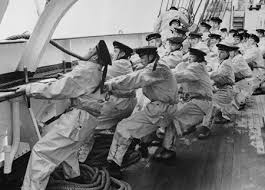
“All Hands on Deck” is defined as an order to every member of a ship’s crew to report to the deck immediately, usually in an emergency.
What is happening in our country at the moment requires this. It is an “all hands on deck” moment which means that you stop whatever it is that you are doing, whatever seems important now, and do what is required. It is a phase so imperative that if you don’t do it, that which was and is important will not matter anymore.
Perhaps we shouldn’t look too far – many countries on the African continent went through the same stages and today their governments struggle to keep their countries functioning. Our story is not a new one, ours is probably going to be one of foolishness where in the face of so many examples, we will have become like many on the continent.
The thing about the “all hands on deck” command is that it is called by the Captain and everybody already knows what they need to do. In our country you can say that many are trying to give this instruction/order/recommendation but they are not recognised. They are not the Captains of the ship. Who then gives the “all hands on deck” command when the emergency that has to be dealt with is the fault of the Captain and even worse those that are close to him? That means you that you cannot even rely on the second in command.
Such is the story that is unfolding right in front of our eyes, where those that are about to sink with the ship are not aware of the “all hands on deck” command and don’t even know what they would have to do even if they did. The ship cannot be steered in any direction of safety because the bridge (control room) itself is occupied by those that are to blame for what is happening.
We need leadership, the kind that will break down the door to the bridge and take over, the kind that will do the unimaginable because the imaginable seems worse than the unimaginable. We are like a house owner watching their house burn. What’s even worse is that we are standing with buckets filled with water, but we are just to dumbfounded by the flames.
I think young people should lead us, the old people are old. And we all know what being old means.
“All hands on deck”. What does this mean? It means that we have reached that moment. Even if we realise now that we have reached that point,
whatever actions we take will not be about saving our country, it will just be about saving the little that’s left of it.
there are many websites that we use to decide on the names to take for whatever we want to name. Some of us even go as far as google the names online when we are pregnant. This is how the naming process is, a name is permanent you don’t want to have a name that you will regret having tomorrow. Hell, most black people have names that they wish they could change now, names like Piet, etc (can’t think of other names, but you know what i mean).








 Given SHINGANGE